

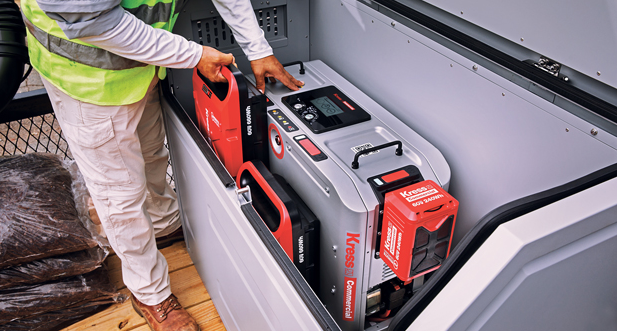

Battery-powered outdoor equipment was once associated mainly with small domestic jobs. Early cordless tools were useful for light trimming or occasional garden work, but they were rarely seen as serious alternatives to petrol-powered professional machinery.
That picture has changed considerably. Improvements in battery capacity, motor efficiency and charging technology have allowed cordless equipment to move into areas that once depended almost entirely on petrol engines. For professional users, schools, estates and large managed grounds, this shift is creating new choices around noise, maintenance, operating costs and day-to-day practicality.
The appeal is not simply environmental. Battery technology is changing how outdoor work can be organised.
Quieter Machines Create More Flexibility
Noise is one of the clearest differences between petrol and battery equipment.
A petrol hedge trimmer, mower or blower can be difficult to use near classrooms, offices, hotels or residential properties without causing disruption. Battery-powered alternatives are generally quieter, which can make it easier to carry out work at times that would previously have been impractical.
For schools, this can be particularly useful. Grounds teams may need to work during the day while lessons are taking place nearby. Quieter equipment gives them more freedom to complete smaller jobs without creating the same level of disturbance.
The same applies to hospitals, care facilities, hospitality venues and managed residential grounds. Noise reduction does not remove the need for sensible working practices, but it can widen the window in which maintenance can take place.
Maintenance Requirements Are Different
Petrol-powered equipment comes with familiar maintenance needs. Fuel systems, spark plugs, oil, filters and engines all require attention. For professional users operating several machines, that maintenance can become a significant part of the workload.
Battery equipment removes some of those components entirely.
Electric motors are generally simpler mechanically, which can reduce the number of routine servicing tasks associated with the machine. That does not mean cordless equipment is maintenance-free. Blades still need sharpening, moving parts still need inspection, and batteries themselves need to be managed carefully.
However, the nature of the maintenance changes. Instead of storing fuel and servicing combustion engines, users need to think about charging, battery health and power management.
For organisations with several machines, this can simplify some aspects of fleet management while creating new considerations around charging infrastructure.
Battery Capacity Has Become the Critical Question
The biggest concern surrounding cordless professional equipment is still runtime.
A domestic user may only need a hedge trimmer for half an hour. A professional grounds team may need to work for several hours at a time. That difference explains why battery capacity and interchangeability have become so important.
Modern professional systems often use high-capacity batteries designed to support more demanding workloads. Some manufacturers also produce battery platforms that can be shared across several tools, allowing the same batteries to be moved between blowers, trimmers, hedge cutters and other equipment.
This can make a significant difference to practicality. Instead of waiting for one machine to recharge, operators can rotate charged batteries and continue working.
The real-world usefulness of any cordless system therefore depends not only on the tool itself but also on the wider battery ecosystem around it.
Charging Strategy Is Becoming Part of Grounds Management
As professional fleets become more battery-based, charging moves from being an afterthought to becoming part of daily planning.
A small organisation may only need a few chargers in a workshop. A larger operation may need a structured charging area with enough capacity to prepare multiple batteries overnight or between shifts.
This introduces new questions.
How many batteries are required to complete a normal day’s work? Can they all be charged at the same time? Is there enough electrical capacity in the storage area? Are batteries being stored at suitable temperatures?
These are very different considerations from keeping petrol available, but they are increasingly relevant as cordless fleets grow.
The organisations that benefit most from battery equipment are likely to be those that plan the charging system alongside the machinery rather than treating each tool as an isolated purchase.
Performance Is No Longer the Automatic Weakness
One reason professional users were historically cautious about battery equipment was power.
Early cordless machines could struggle with thick vegetation or sustained heavy workloads. Modern brushless motors and improved battery output have narrowed that gap considerably.
In many applications, battery tools can now provide enough power for serious professional use. Hedge trimmers, blowers and brushcutters are among the areas where cordless technology has become particularly credible.
Larger mowing equipment is also moving in the same direction, although the demands are greater because of the energy required to operate for long periods over large areas.
This means the choice between petrol and battery is becoming less about whether cordless equipment can work at all and more about whether it suits the particular job.
The Environmental Argument Still Matters
Battery equipment can reduce local exhaust emissions because there is no combustion engine operating during use.
That can be important in enclosed courtyards, near buildings or on sites where environmental policy is becoming more prominent.
It can also help organisations reduce their dependence on petrol for routine maintenance.
However, battery technology is not impact-free. Batteries require raw materials and energy to manufacture, and their environmental value depends partly on how long they remain useful and how they are handled at the end of their life.
A sensible sustainability assessment therefore looks at the entire lifecycle rather than simply comparing emissions at the point of use.
The advantage is strongest when batteries are used heavily, maintained properly and kept in service for as long as possible.
Professional Suppliers Are Adapting Too
As the market changes, the role of specialist suppliers is changing with it.
Businesses such as Ron Smith now operate in a groundcare market where customers may be comparing petrol and battery systems side by side rather than treating cordless equipment as a niche option.
That changes the buying conversation.
A customer may need advice not only on cutting width or engine power, but also on battery compatibility, runtime, charging requirements and whether one battery platform can support several machines.
For professional buyers, this wider systems approach is increasingly important. Choosing the wrong battery platform can lead to unnecessary duplication, while a well-matched system can simplify the entire equipment fleet.
Petrol Equipment Is Not Disappearing
Battery technology is improving quickly, but petrol machinery still has advantages.
For very long working days, remote locations or extremely demanding applications, refuelling a petrol machine can still be faster and simpler than managing batteries.
Some professional users may also prefer petrol where charging infrastructure is limited.
The transition is therefore unlikely to be immediate or universal.
Many organisations may operate mixed fleets for years, using battery equipment where its strengths are most valuable and retaining petrol machines for heavier or longer-duration work.
That hybrid approach may actually be the most practical path for many grounds teams.
A Shift in How Outdoor Work Is Planned
The most important change created by battery technology may not be the machine itself. It is the way grounds maintenance is organised.
Quieter tools can be used at different times. Simpler motors change maintenance routines. Shared battery platforms affect purchasing decisions. Charging introduces a new layer of planning.
In other words, cordless technology is not just replacing petrol engines. It is changing the systems around outdoor equipment.
As batteries continue to improve, the gap between cordless and traditional machinery is likely to narrow further. For professional users, the question is increasingly moving away from whether battery equipment is viable and towards where it makes the most sense.
That is a much more significant shift than simply swapping one power source for another.