

Key Highlights
| Study Period | 2019 – 2032 |
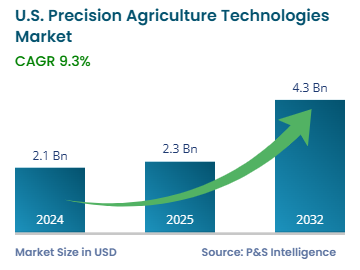
| Market Size in 2024 | USD 2.1 Billion |
| Market Size in 2025 | USD 2.3 Billion |
| Market Size by 2032 | USD 4.3 Billion |
| Projected CAGR | 9.3% |
| Largest Region | Midwest |
| Fastest Growing Region | South |
| Market Structure | Fragmented |
Market Size
Major Companies
Important Takeaways
|
Explore the market potential with our data-driven report
U.S. Precision Agriculture Technologies Market Analysis
The size of the U.S. Precision Agriculture Technologies Market in 2024 was USD 2.1 billion, and it will reach USD 4.3 billion by 2032 at a CAGR of 9.3% during 2025–2032.
The market is growing due to the rising food requirements, workforce gaps, and escalating expenses for running farming operations. Corporations are now offering next-generation agricultural technology, which includes autonomous tractors, variable rate technology, and real-time farm management software to enhance farm operational efficiency.
The agriculture sector in the United States plays a vital role in the economy, with nearly 900 million acres of land allocated for farming, representing approximately 40% of the nation’s total land area. There are about 2 million farms throughout the country, which vary from small family-run operations to large-scale commercial farms. This sector provides employment for around 2.6 million agricultural workers, encompassing both permanent and seasonal staff. A substantial number of these workers are permanent, while seasonal laborers—who are typically recruited during the planting and harvesting periods—are essential for the cultivation of labor-intensive crops. The industry continues to face challenges related to labor shortages, particularly concerning seasonal workers.
The GPS-guided machinery equipment with sensors, drones, and artificial intelligence permits farmers to base their decisions on data, which results in better output production, reduced waste, and more efficient resource management. The farming method boosts operational efficiency and contributes to sustainable practices through reduced water usage, fertilizers, and pesticide use.
U.S. Precision Agriculture Technologies Market Segmentation Analysis
Insights by Technology
Guidance systems lead the market with a revenue share of 45%, as GNSS/GPS ensures farmers perform their work reliably through accurate assessments. The U.S. Department of Agriculture (USDA) allocated USD 300 million in 2022 toward a new Climate-Smart Commodities Initiative, funding precision ag practices like variable-rate fertilizer and carbon tracking tools. GNSS/GPS systems provide farmers with equipment positioning abilities that enable accurate field placement of equipment, pinpoint fertilization, and spraying applications.
GNSS/GPS systems operate at high levels of precision, which eliminates duplicate uses of resources and optimizes the usage of seeds, water, and pesticides. Through GNSS/GPS technology, farmers can create detailed field maps and monitor crop conditions with real-time yield and equipment performance data. Essentially, the need to enhance productivity and decrease resource consumption drives farmers to adopt this technology.
The technologies analyzed here is:
- Guidance Systems (Largest Category)
- Remote Sensing
- Variable Rate Technology (VRT) (Fastest-growing category)
- Automated Machinery & Robotics
- Farm Management Software & Data Analytics
Insights by Component
Hardware led the market in 2024 with a share of 55%. Modern farming depends on essential tools with automation technology, which integrates control systems, GPS devices, and sensing equipment found within this category. These technologies enable farmers to gather real-time data about soil moisture levels, crop condition, and equipment reliability, which helps them make choices that help in growth and higher yield rates. Advanced agricultural hardware maximizes resource usage, lowers expenses, and boosts agricultural output.
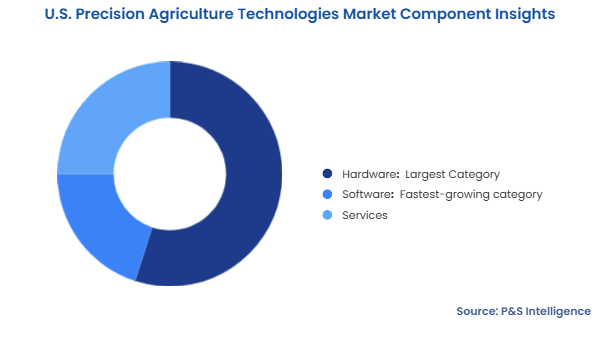
The components analyzed here are:
- Hardware (Largest Category)
- Software (Fastest-growing category)
- Services
Insights by Application
The crop monitoring & management category has the largest revenue share, of 45%. The advanced technology tools, including remote sensing, drones, and IoT-enabled sensors, monitor plant health and disease detection while evaluating growth and development in real time. The use of IoT sensors and satellite imagery increased crop yields by up to 20% on average and reduced water usage by 50% in recent pilot studies across Californian almond and Midwestern corn farms.
These tools grant farmers exact data in real-time for making choices that increase yield quality and quantity. These technologies boost productivity levels and minimize input expenses. The AI machines and learning methods generate exact examinations of big data sets to guide proper interventions and resource distribution. The primary role of Crop Monitoring & Management in precision agriculture has maintained dominance due to its representation of a major transformation towards farming based on data analytics.
The applications analyzed here are:
- Crop Monitoring & Management (Largest Category)
- Soil & Field Analysis
- Irrigation Management (Fastest-growing category)
- Planting & Seeding
- Fertilization & Crop Protection
- Harvesting & Yield Monitoring
Drive strategic growth with comprehensive market analysis
U.S. Precision Agriculture Technologies Market Regional Market Performance
The Midwest region leads the market with a share of 45%, as it encompasses extensive farmlands characterized by high agricultural fertility. The Corn Belt designation describes this agricultural zone that produces major amounts of national corn and soybean production. The farmers of the Midwest extensively use precision farming devices, such as GPS steering tools, yield tracking programs, and soil analysis systems, to optimize resource use and boost productivity.
According to the USDA, within the Midwestern region stretching from North Dakota to Texas, numerous counties report that over 70% of their land is utilized for farming. Following Texas, the states with the highest number of farms in the nation include Missouri, Iowa, Oklahoma, Ohio, Kentucky, Illinois, Tennessee, California, and Minnesota, the majority of which are located in the Midwest.
The large-scale farming in this region allows major operations to use advanced techniques since it gives them increased economic opportunities alongside better affordability. The adoption of precision agriculture practices became possible through government support and agricultural research institutions combined with favorable policies. Through its commitment to innovative farming solutions, the Midwest leads in allowing substantial support for the overall expansion of the precision agriculture market in the United States.
The regions analyzed here are:
- Northeast
- Midwest (Largest Region)
- West
- South (Fastest-growing region)
link