

Literature review on digital technology innovation
Initially, this paper must elucidate the connotation and scope of EDIG. EDIG denotes the utilization of digital technology and information and communication technology to develop innovative goods, services, and business models via the collecting, processing, transmission, and application of data. This innovation encompasses not only hardware devices (such as computers, sensors, and network equipment) but also, more significantly, software applications, data analysis, artificial intelligence, cloud computing, and other facets17. EDIG integrates technologies including information, computing, communication, and connectivity through its unique combinatorial attributes, consistently achieving sustainable growth by leveraging data homogenization and reprogramming capabilities. It transcends the limitations of industries, organizations, departments, and products to foster convergence across diverse domains1. The scope of EDIG encompasses diverse domains, ranging from personal affairs to corporate governance, from industrial manufacturing to urban administration, significantly influencing social and economic advancement.
The formation of the EDIG ecosystem is essentially a collaborative innovation network with the participation of multiple subjects, and its evolution process presents the dual characteristics of vertical deepening and horizontal extension of the technical dimension, and shows a cross-domain, cross-border and decentralized collaborative innovation mechanism18. In the convergence and evolution of computer science, Internet technology and microelectronic communication technology, physical device components gradually have the digital attributes of programmability, addressability, traceability and interconnection. This technology convergence effect has pushed traditional brick-and-mortar organizations such as paper media, retail entities, and industry research institutions to derive digital virtual twins in the digital space. At the same time, transactions, decision-making, office and communication in traditional economic activities have gradually migrated to the digital space, forming a new operating paradigm. It is worth emphasizing that the breakthrough of basic information and communication technology not only provides a nurturing soil for open digital technology innovation, but also promotes the iterative upgrading of the information and communication technology system through the diffusion and application of its technological achievements, thus forming a two-way promotion mechanism for technology evolution and innovation diffusion19.Following the market’s adoption of digital technology, both supply and demand entities have acknowledged its significance and exhibit a growing need for convenient, personalized, and intelligent products and services20. Organizations depend on their internal technical resources to cultivate and excel in sophisticated digital technological advancements. Conversely, collaborative research institutions conduct investigations in digital technologies. The dual digital technology requirements of users and companies motivate R&D groups at all tiers to pursue EDIG innovations and employ digital analytics to reassess and reinterpret market demands21. The government’s policies on technological innovation, digital city initiatives, digital infrastructure development, and intellectual property frameworks serve as an unseen “third hand” for EDIG. The institutional influence on information technology innovation stems from the ideological convergence of institutional authority and regulatory power, alongside the supply-driven and demand-pulled innovation models22. Institutional empowerment aims to establish a robust and sustainable digital platform and ecological environment for the “social-technological system” of digital infrastructure.
Various forms of novel EDIG outputs possess distinct properties of digital efficacy. The development of the APP application, featuring virtually unlimited space, enables the creation of numerous client applications dependent on electronic devices and network platforms. This significantly addresses the demands of daily life and entertainment, facilitating one-click access to payment, subscription, finance, and other services, while also offering opportunities for customer feedback23. Innovative technologies and devices, such as smartphones, computers, autonomous vehicles, and smart wearables, significantly enhance the functionalities of conventional machines while transforming the methods by which individuals obtain and share information. Exhibits the efficacy of digital technology in the development of innovative products21; The manufacturing, production, distribution, and utilization processes depend on essential digital technologies for the construction of sensing equipment. Unmanned detection and identification enhance the transparency of enterprise production processes, while artificial intelligence and the Internet of Things facilitate remote patient monitoring and treatment24, thereby fostering the innovative advancement of traditional production methods. The amalgamation of information, computing, communication, and connectivity technologies has engendered an intelligent system that integrates transaction payments, decision-making, and organizational management. This evolution has transformed enterprise collaboration and interaction, optimized operational modalities through the establishment of a digital supply chain25, and enhanced the efficacy of business models and organizational innovation through digital technology. EDIG significantly contributes to the enhancement of social products, the optimization of production processes, the advancement of organizational governance, and the innovation of business models, profoundly influencing economic and social growth.
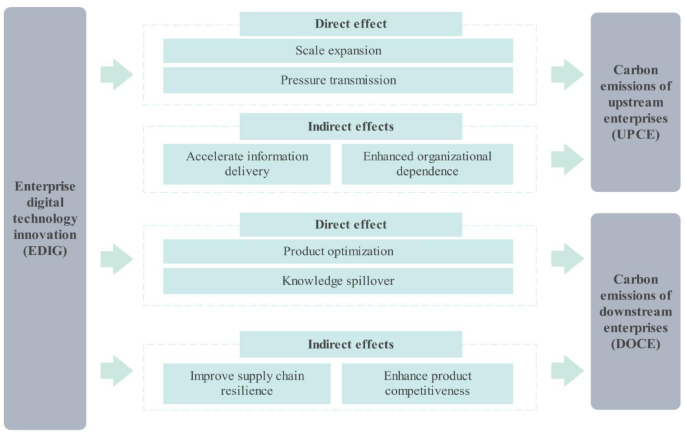
EDIG influences the action mechanism of CE
Direct effect
The EDIG of targeted firms will enhance the CE of upstream enterprises via the scaling effect. Digital innovation by focus enterprises may enhance their production efficiency, product quality, or market competitiveness26. Utilizing big data research to precisely identify market demand, digital marketing strategies are employed to increase market share. This directs firms to increase the demand for upstream raw materials, components, and similar resources. To accommodate the rising order demand from focus firms, upstream enterprises must enlarge their production capacity. Consider a vehicle manufacturing business that achieved intelligent production scheduling and personalized customization services via EDIG, resulting in a substantial rise in car sales. To satisfy the demands of automobile manufacturers for additional components, upstream suppliers must augment manufacturing lines and prolong production durations. Furthermore, the increase in production size results in heightened energy usage. As the operational duration and production intensity of upstream firms increase, total energy consumption will rise, regardless of whether traditional or renewable energy sources are utilized. Furthermore, during the initial phases of production scale expansion, energy consumption per unit of output may increase, as enterprises may lack the opportunity to establish effective energy management systems for new machinery or to improve production processes. Simultaneously, the extraction, processing, and transportation of raw materials will generate increased carbon emissions as a result of the expanded manufacturing scale. Steel production firms, as the upstream of auto parts manufacture, would consequently see an increase in energy consumption and carbon emissions in their iron and steel processes to supply more steel.
Conversely, digital innovation in focused firms may enhance corporate entrepreneurship in upstream firms via pressure transmission within the supply chain. During this process, upstream companies may experience pressure from focused companies to require increased delivery times and enhanced product quality, among other demands27. To fulfill these requirements, upstream firms may implement emergency measures, including augmenting spare capacity and accelerating the frequency of raw material transit. For instance, target companies are requiring reduced lead times from upstream companies using digital supply chain technologies. To guarantee timely delivery, upstream firms may augment inventory, necessitating additional storage space and logistics movement, hence escalating energy consumption and carbon emissions. Furthermore, upstream firms may lack sufficient resources or technology to synchronize the implementation of low-carbon technologies in response to the increased demand generated by the digital innovations of focused enterprises. In comparison to focused firms, upstream enterprises may be smaller in scale or possess limited technological capabilities, making the rapid adoption of efficient energy-saving and emission-reduction technologies challenging. For instance, certain small raw material processing enterprises, confronted with a sudden surge in orders, may be unable to timely replace their production equipment with more energy-efficient alternatives or optimize their production processes. Consequently, they must rely on extending the operational hours of existing equipment to satisfy demand, leading to an increase in CE. Consequently, the subsequent hypothesis is posited:
Hypothesis 1a
The focused enterprise EDIG can enhance the customer experience of the upstream enterprise.
The technological innovation of focus firms has a transmission effect. The supply chain transmission theory posits that technology exhibits a directional preference in its dissemination, with variations in the motivations, barriers, and costs associated with technology sharing. Consequently, the recipients of technology transmission are typically downstream enterprises rather than upstream ones28. Digital innovation in targeted companies can facilitate the creation of lower-carbon products. For instance, enhancing product design via digital technology, employing computer simulations and other methods to minimize material usage, or utilizing more sustainable materials. Upon utilization of these low-carbon products by downstream firms, there will be a direct reduction in the carbon emissions of these enterprises during the product usage phase. Concentrated enterprise digital innovation may also result in service innovation. For instance, Focus firms are leveraging digital technology to enhance logistics and distribution services, including intelligent path planning and vehicle scheduling technologies to minimize energy loss in transportation. Downstream firms, as service users, can leverage these low-carbon services to diminish their carbon emissions.
Conversely, there exists a knowledge spillover effect in the technological innovation of targeted firms. The digital innovation accomplishments of focused firms may transfer to downstream enterprises via technical collaboration, industry exchanges, and other avenues29. The focused firms engage in collaborative research and development initiatives with downstream entities to exchange expertise and technology related to digital advancements in production management, energy conservation, and emissions reduction. Companies emphasizing digital innovation may compel downstream firms to enhance their technologies. When downstream firms observe that focused enterprises have achieved low-carbon benefits through digital technology, they will be motivated to adopt analogous digital technologies or implement corresponding technological reforms. For instance, when upstream machinery manufacturing firms attain intelligent manufacturing and low-carbon production via digital innovation, downstream enterprises utilizing machinery products will similarly undergo digital transformation of their production processes to align more effectively with the offerings of upstream firms, consequently decreasing CE. Consequently, the subsequent hypothesis is posited:
Hypothesis 1b
The focused enterprise EDIG can diminish the CE of downstream enterprises.
Indirect effects
The focused firms achieve enhanced supply chain management by technical innovation, including the implementation of a real-time supply chain information system that mandates upstream enterprises to deliver immediate distribution services. To fulfill this obligation, upstream firms must sustain a specific level of safety inventory. To guarantee the sufficiency and freshness of the inventory, the frequency of acquisition and transportation of raw materials may be augmented30. For instance, focus organizations necessitate upstream food raw material suppliers to accomplish daily small batch, multi-batch distribution. To fulfill this requirement, providers must regularly acquire raw materials from farms and augment the fleet of transport trucks, resulting in heightened energy consumption and carbon emissions during transportation. The supply chain collaborative information system of the focused firm may necessitate the upstream enterprise to integrate its information system with it. Upstream firms must allocate money for system enhancements and maintenance to facilitate information sharing with focused enterprises. This process involves energy consumption, whether updating hardware or maintaining software systems. For instance, upstream firms must acquire new servers to manage the substantial data interactions with the focused enterprise, and the operation and cooling of these systems necessitate electricity consumption, hence elevating CE.
In certain industrial ecological contexts, a strong collaborative relationship exists between focused firms and upstream enterprises, which is further intensified following innovation. In a substantial industrial cluster, following the innovations of key enterprises, it is essential for these enterprises to ensure that the production plans and operational rhythms of upstream entities are meticulously aligned with their own to maximize overall production efficiency and facilitate the effective implementation of their innovations. To sustain collaboration with focused enterprises, upstream enterprises must organize production in accordance with their specifications, potentially leading to an excessive dependence on the directives of focused enterprises and a loss of flexibility in their own production strategies. For instance, focus firms reduce the product production cycle post-innovation, necessitating upstream enterprises to abbreviate the supply cycle. To fulfill this requirement, upstream firms may enhance the operational intensity of the manufacturing line and perhaps augment spare capacity, which will inevitably elevate energy consumption and expedite CE. Simultaneously, following the innovation of focus firms, the demands for product quality and supply consistency from upstream enterprises would also escalate. Due to organizational dependencies, upstream firms must endeavor to fulfill these needs. To maintain product quality requirements, upstream firms may allocate additional resources to quality control, including the utilization of advanced testing equipment and intricate production processes, resulting in increased energy consumption. To guarantee supply stability, upstream industries may augment stockpiles and create additional warehouses, which will also necessitate increased energy consumption during both building and operation, so expediting CE. Consequently, we put up the subsequent hypothesis:
Hypothesis 2a
Focused enterprise EDIG can enhance CE for upstream firms by expediting information dissemination and reinforcing organizational interdependencies.
Innovation actions by targeted organizations can significantly enhance supply chain resilience, hence mitigating circular economy challenges in downstream firms. During the innovation process, firms may allocate resources towards technological research and development or the enhancement of management models to bolster the supply chain’s capacity to address diverse risks and uncertainties, thereby improving supply chain resilience. In light of these possible hazards, enhancements in supply chain resilience allow for prompt modifications to maintain supply continuity. For downstream companies, this implies that their production operations will not be compelled to cease or implement emergency measures characterized by elevated energy consumption and emissions owing to supply shortages. For instance, if the primary enterprise anticipates a potential shortage of a crucial raw material and secures a steady supply for the downstream enterprise by coordinating with alternative suppliers or modifying inventory distribution, the downstream enterprise can avoid activating its high-energy standby production plan to urgently procure raw materials, thereby preventing additional energy consumption and an increase in carbon emissions resulting from emergency production. Significantly reduce the CE of downstream industries. Moreover, the emphasis on enterprise innovation may also manifest in the enhancement of supply chain configuration. By strategically arranging warehouse sites and logistics routes, the entire supply chain may adapt its operational mode more flexibly in response to natural disasters and market variations. Consequently, downstream firms can obtain raw materials and product distribution more seamlessly and efficiently, minimizing energy loss and carbon emissions resulting from transportation delays, inventory surplus, and other issues. The innovative supply chain configuration minimizes the transportation distance of products from the focused enterprise to the downstream enterprise, enhances the predictability of transportation time, increases the utilization rate of transportation vehicles, and reduces unnecessary energy consumption, thereby mitigating the carbon emissions of downstream enterprises.
Focused enterprises can achieve significant competitive advantages through innovation, and this competitive advantage can mitigate the carbon emissions of downstream enterprises in various ways. Firstly, the competitive advantages brought by technological innovation for focused enterprises may manifest in improvements to product quality and performance. When focused enterprises develop superior and more efficient products and bring them to market, downstream enterprises, as technology recipients, can achieve immediate emissions reductions through equipment upgrades. For example, when focused enterprises develop a new type of energy-saving equipment through technological innovation, downstream enterprises can significantly reduce energy consumption in their own production processes after purchasing and applying this equipment. This is because this energy-saving equipment requires less energy to operate compared to traditional equipment, thereby reducing carbon emissions in the production process of downstream enterprises and effectively mitigating carbon emissions. Secondly, the competitive advantage derived from the innovation of specialized firms may also manifest in the enhancement of service quality. For instance, the focused firms have revolutionized logistics distribution services, implemented intelligent scheduling systems, optimized transportation routes, and employed various strategies to expedite and enhance the accuracy of product delivery to downstream enterprises. This enhances the production efficiency of downstream firms, allowing for more rational production planning, preventing production delays or accelerations due to late product arrivals, and minimizing additional energy consumption and costs associated with transportation. Moreover, the competitive advantage attained by innovative firms frequently commands a greater market share and wields a more influential presence. This enables focus companies to guide the market towards a more environmentally friendly and sustainable trajectory. For instance, the focused enterprises may establish cooperation agreements with downstream enterprises that include environmental protection stipulations, mandating downstream enterprises to implement specific energy-saving and emission reduction strategies during production, or to offer pertinent technical assistance and training to enhance the environmental protection competencies of downstream enterprises, thereby mitigating their carbon emissions.
Hypothesis 2b
The focused enterprise EDIG can diminish the CE of downstream enterprises by augmenting supply chain resilience and enhancing product competitiveness.
Regulatory effect
Command-based environmental regulation pertains to the government’s direct oversight of the environmental conduct standards of businesses, including specified pollutant emission restrictions and minimum energy efficiency criteria. This regulatory framework is obligatory and prescriptive31.
On one hand, focused enterprises primarily concern themselves with their ability to comply with the stipulated norms of this law. When a company prioritizes technological innovation, such as enhancing its production processes to elevate quality or efficiency, its primary emphasis may be on fulfilling its regulatory obligations. To adhere to statutory environmental standards, the concerned firms will incur compliance expenses. The expenses encompass the acquisition of environmental equipment, environmental monitoring, and the settlement of associated environmental taxes and levies. Due to constrained cash, the investment in technology innovation by targeted firms will be prioritized to fulfill their regulatory obligations. This has resulted in a relative decrease in cash and energy for collaborative innovation with upstream firms to diminish upstream CE. Furthermore, knowledge asymmetry may exist between focused firms and upstream enterprises. The focused enterprises may lack a comprehensive understanding of the production processes and circular economy connections of upstream enterprises, hence complicating efforts to influence the circular economy of upstream enterprises through technical innovation. The coordination of innovation activities between upstream and downstream firms incurs substantial transaction costs, encompassing communication expenses and costs associated with contract negotiation and execution. Under the command type environmental regulation, the focus firms are more prone to pay attention to their own direct regulatory pressure, and minimize the investment in such high-cost cooperative innovation, thus diminishing the promotion function of upstream enterprises CE. Conversely, enforced environmental restrictions generate a distinct demand signal for sustainability in the market. When the government mandates that downstream products adhere to specific environmental standards (such as emission regulations for vehicles and energy efficiency criteria for household appliances), downstream enterprises must comply with these requirements to legally market their products. The technical advancements of focus organizations may more effectively respond to this demand. For instance, the focused enterprises have created more energy-efficient components, enabling downstream home appliance assembly firms to readily comply with governmental energy efficiency regulations, thereby improving the market competitiveness of their products. Furthermore, command-based environmental regulation promotes enhanced supply chain cooperation among both focused firms and downstream entities. To comply with regulatory mandates, downstream firms will proactively pursue collaboration with focused enterprises, necessitating the provision of more ecologically sustainable and low-carbon products or technologies from the latter. The technology advancements of the focused enterprises can be disseminated more efficiently across the supply chain. We establish the subsequent assumptions:
Hypothesis 3a
Command-type environmental regulations may diminish the positive impact of technical innovation by focused firms on the circular economy of upstream enterprises.
Hypothesis 3b
Command-type environmental regulations can enhance the capacity of focused firms’ technological innovations to reduce carbon emissions in downstream enterprises.
Non-command environmental regulation primarily encompasses economic incentive regulation (including tax incentives and subsidies) and voluntary regulation (such as voluntary corporate participation in environmental protection agreements and environmental management system certification). This type of regulation is comparatively adaptable, allowing firms greater autonomy in decision-making32.
For focused firms, the influence of technical innovation on the circular economy of upstream enterprises is less clearly defined by non-command environmental rules compared to command regulations, which offer more explicit statutory requirements and guidance. The influence of technology innovation on upstream circular economy necessitates collaborative efforts and resource allocation from both parties. Nonetheless, non-mandatory environmental rules typically fail to provide adequate incentives or limitations for joint emissions reduction between upstream and downstream entities. Upstream firms may lack sufficient motivation to align with the innovative endeavors of focus firms aimed at reducing CE, as they do not encounter direct regulatory pressure. For instance, targeted firms receive tax incentives for technological innovation, anticipating that upstream enterprises will enhance the raw material production process to decrease CE; however, upstream enterprises may be hesitant to respond favorably because to the trade-off between costs and benefits. Furthermore, the economic incentives associated with non-command environmental control mostly concentrate on the emission reduction actions of the targeted firm, rather than its indirect effects on the circular economy of upstream enterprises. This causes the focused firms to give insufficient consideration to the circular economy issues of upstream enterprises during the innovation phase, leading to a negligible promotional effect. Conversely, economically incentivized non-mandatory environmental laws (such as tax incentives and subsidies) might encourage targeted firms to pursue technological innovation. When focused firms get economic incentives for technological innovation, their innovation outcomes can be transmitted to downstream enterprises via the supply chain, so enhancing the carbon emission reduction efforts of those downstream entities. Secondly, non-command environmental regulation enhances the ecological aspect of market competition. The demand for eco-friendly products among consumers and the market’s focus on the environmental reputation of companies have compelled these firms to offer more sustainable products and services via technical innovation. To satisfy consumers’ environmental demands and improve their market competitiveness, downstream enterprises will proactively implement the innovations of leading firms. We establish the subsequent assumptions:
Hypothesis 4a
Non-command environmental regulation does not significantly influence the relationship between focused enterprises’ promotion of circular economy in upstream enterprises.
Hypothesis 4b
Non-prescriptive environmental regulation can enhance the promotional function of focused enterprise EDIG in reducing carbon emissions of downstream enterprises.
link