


Descriptive statistics
Table 2 presents the descriptive statistics of the main variables. The green innovation variable (Ginv) had a maximum value of 6.746 and a minimum value of 0, indicating significant variability in green innovation performance across the firms in the sample. The median value was 0, and the mean was only 0.272, which was significantly lower than the maximum, indicating that the majority of firms either did not engage in green invention patenting or maintained only a minimal level of such activity during the study period. Overall, the level of green innovation remained relatively low across the sample. This result is consistent with the findings of previous studies, including Li et al. (2023) and Liu et al. (2025), indicating that Chinese companies are still in the early or non-standardised phase of green patent production.
The variable GAlliance had a mean value of 0.043 and a standard deviation of 0.203, suggesting that ~4.3% of the sample firms engaged in an environmental strategic alliance during any given year, reflecting a relatively low incidence rate. However, from the perspective of a “specialised strategic alliance,” such a low frequency is theoretically justifiable. Zou et al. (2024) and Chemmanur et al. (2023) emphasise that specialised strategic alliances—such as R&D alliances and supply chain alliances—are typically established among a specific subset of firms, particularly those with established environmental reputations or those facing substantial external policy pressure. Consequently, although the mean value of the GAlliance variable was relatively low, it captured the fundamental nature of environmental strategic alliances as a “scarce yet efficient” form of specialised collaboration.
Concerning the control variables, Size had a mean value of 22.19, which suggests that the sample was predominantly composed of medium-to-large publicly listed companies, consistent with Chen et al. (2024a, 2024b), who observed that larger firms tend to foster green innovation more effectively. LEV had a mean value of 0.436, indicating a moderate level of leverage across the firms in the sample. This result supports the contention of Wang et al. (2024) that firms with moderate levels of debt are more inclined to pursue green innovation. Furthermore, ROA has a value of 0.039, indicating that most firms experienced stable financial performance and had sufficient surplus capacity to invest in innovation. This finding supports the conclusion of Lei et al. (2025), who highlight that strong financial conditions are favourable for green corporate innovation.
The mean value of TOP1 was 33.96%, reflecting a relatively high level of control concentration, which aligns with the results of Makpotche et al. (2024), who highlight that concentrated ownership improves shareholder oversight, which, in turn, promotes green innovation within companies. The mean value of Mshare was 12.11%, indicating that most companies had managerial incentives in place, an arrangement that, according to Zhao et al. (2025), is theoretically favourable for encouraging green innovation. These statistics further highlight the representativeness of the sample, offering a strong basis for ensuring the internal validity of the regression analysis.
Empirical analysis
Table 3 displays the findings of the benchmark regression that explored the connection between strategic environmental alliances and corporate green innovation. The regression coefficient for the environmental strategic alliance variable (GAlliance) was 0.057, statistically significant at the 1% level. This finding suggests that involvement in strategic environmental alliances has a significant positive impact on corporate green innovation. This result supports H1.
The regression outcomes for the control variables generally aligned with the results reported in previous studies. For example, the coefficient for Size was 0.055, which was statistically significant at the 1% level. This finding suggests that larger firms have more resources and higher risk tolerance, enabling them to pursue green innovation, which is consistent with Chen et al. (2024a, 2024b). Similarly, the coefficient for Mshare was positive and significant at the 5% level, indicating that managerial equity incentives increased executives’ likelihood of adopting long-term green strategies. This finding is consistent with Zhao et al. (2025), who highlight the importance of internal incentives in fostering a green strategic orientation. Moreover, Loss showed a notable negative impact on green innovation, with a coefficient of −0.023, which was statistically significant at the 5% level. This result implies that companies facing financial difficulties tend to cut back on green R&D investments, which are generally long-term and involve extended payback periods, which is consistent with the findings of Zhang et al. (2024).
Endogeneity discussion
Mitigating the impact of measurement errors
Given that reliance on a single measurement approach may introduce measurement errors, potentially affecting the accuracy of model estimates and the reliability of the conclusions, this study employed alternative measurements of core variables to test the robustness of the primary findings.
First, concerning an alternative measurement for the environmental protection strategic alliance variable, this study adopted the methodology of Wen et al. (2023) and used text analysis to reassess the level of firms’ involvement in these alliances. Specifically, the analytical sample consisted of strategic alliance announcements made by listed companies, with the frequency of keywords related to environmental protection in these announcements being measured. Higher keyword frequency indicates greater attention to environmental issues and a deeper level of engagement in alliance-based cooperation, reflecting a firm’s commitment to embedding environmental concerns in its core strategic agenda. To construct the alternative variable GAlliance1, keyword frequency was incremented by one and then transformed using a natural logarithm to quantify the actual level of firm participation in environmental protection through strategic alliances.
Second, as part of the alternative measurement of green innovation, this study extended the original index by incorporating two additional indicators: the number of green utility model patents filed independently and the number of those fields filed jointly, which typically cover application-oriented technologies such as green production equipment, process innovations, and methods aimed at energy conservation and consumption reduction, particularly in manufacturing and related sectors. Their inclusion allowed a more comprehensive assessment of firms’ green technological innovation, thus complementing invention patents by capturing practical and implementation-level innovation activities. To construct the alternative variable Ginv1, the total number of the four types of green patents was aggregated, incremented by one, and then transformed using the natural logarithm.
The regression outcomes with alternative variables confirmed that the positive influence of environmental protection strategic alliances on green innovation continued to be statistically significant (see column (1) of Table 4). Additionally, the direction of the estimated coefficient aligned with that of the main model, suggesting that the key findings of this study remained robust after alternative measurement methods had been used.
Addressing the influence of mutual causation
Although this study accounted for various firm-level variables and included fixed effects, the possibility of endogeneity due to reverse causality remained a concern. Firms with strong green innovation capabilities and higher levels of environmental governance tend to be more environmentally conscious and are, therefore, more inclined to engage in green collaborations, including participation in environmental protection strategic alliances. This dynamic could lead to a two-way causal link between a firm’s green innovation performance and its participation in alliances, introducing potential endogeneity due to mutual causation, which could distort the results of the benchmark regression.
To mitigate these potential endogeneity issues and enhance the reliability of the causal inferences, this study applied a two-stage least-squares (2SLS) approach. The fundamental concept behind this method is to separate the endogenous part of the explanatory variable using an exogenous instrument. This instrument should be strongly correlated with the endogenous regressor, but not with the error term of the dependent variable, thus enhancing the precision of the causal estimates.
According to Wassmer (2010), firms’ choices to engage in strategic alliances are frequently shaped by the behaviour of other companies within their industry. When other companies within the same industry widely engage in environmental protection strategic alliances, they become more likely to follow suit, driven by competitive pressure, resource complementarity, or institutional imitation. Drawing on the theoretical framework and methodological approach of prior research, this study created an instrumental variable, IV, defined as the proportion of other publicly listed firms in the same industry that were involved in environmental protection strategic alliances during the previous year. The construction of this instrumental variable can be considered methodologically sound for two primary reasons:
① Relevance: In line with institutional diffusion theory and the empirical findings of Wassmer (2010), a firm’s probability of engaging in strategic alliances is strongly affected by the alliance activities of its peer firms within the same industry. Thus, the instrumental variable exhibits a strong correlation with firms’ participation in environmental protection strategic alliances.
② Exogeneity: The instrumental variable is determined entirely by the alliance actions of other companies within the same industry, explicitly omitting the behaviour of the focal firm. Therefore, it is improbable that the instrumental variable would directly affect the firm’s green innovation results, ensuring that the exogeneity condition is met.
The results of the 2SLS regression are presented in Column (2) of Table 4. The positive effect of environmental protection strategic alliances on firms’ green innovation was statistically significant. Additionally, the F-statistic for the instrumental variable in the first-stage regression far surpassed the usual threshold of 10, suggesting that weak instrument bias was not present and validating the instrument’s robust explanatory capacity. These results imply that the main conclusions of this study remained reliable and valid, even when potential reverse causality was considered, thus offering more robust evidence for causal interpretation.
Addressing sample selection bias
The descriptive statistics revealed that only a minority of the firms in the sample participated in environmental protection strategic alliances. Furthermore, notable differences existed in the firm-level characteristics between companies that participated and those that did not. This suggests that alliance participation is unlikely to be random; rather, it reflects a strategic decision made by firms in response to specific contextual factors such as resource endowments, regulatory pressure, or alignment with green development strategies. This non-random selection may have resulted in sample selection bias. Specifically, firms that participate in strategic alliances for environmental protection may inherently possess stronger green innovation capabilities and higher environmental awareness. This self-selection mechanism may introduce endogeneity into the estimation, potentially resulting in an inflated estimate of the impact of alliance participation on green innovation.
To correct for sample selection bias, this study adopted the methodology of Lee et al. (2022) and utilised the entropy balancing technique to adjust the weights of the sample observations. This semi-parametric reweighting method was used to align the distribution of covariates in the treatment group (firms involved in environmental protection strategic alliances) with that of the control group (firms that did not participate). By aligning these covariate distributions, the method effectively reduced the systematic bias arising from the non-random sample selection. To implement the entropy-balancing procedure, this study defined participation in an environmental protection strategic alliance as a treatment variable. The covariates included Size, LEV, ROA, Loss, Mshare, Board, TOP1, and Balance1. These variables comprehensively reflect firms’ resource endowments, profitability, and corporate governance structure, which are key factors influencing a firm’s strategic decision to voluntarily engage in green collaboration. The regression outcomes for the reweighted sample are shown in Column (3) of Table 4. The positive impact of environmental protection strategic alliances on firms’ green innovation continued to be statistically significant, suggesting that the core findings were not influenced by sample selection bias, further affirming the robustness of the analysis.
Testing using the DID method
Eliminating potential endogeneity arising from omitted variables remained challenging. In particular, unobservable and time-invariant firm characteristics such as a firm’s strategic orientation toward green innovation, its environmental culture, and the values held by its management team may simultaneously influence both participation in environmental protection strategic alliances and green innovation outcomes, thereby introducing bias into the estimated results. To address these potential endogeneity issues, this study adopted a combined identification strategy using entropy balancing and the DID method to enhance the validity and robustness of the causal inference. In contrast to directly using the DID approach only, the combined strategy of “entropy balancing + DID” allowed for adjustment for structural disparities in covariates between the treatment and control groups. By ensuring full covariate balance prior to DID estimation, this approach yielded more reliable and interpretable results.
In this study, the year in which a firm first joined an environmental protection strategic alliance was designated as the event year. The treatment variable, GAlliance2, was defined as 1 beginning in the year of the event and remained 1 in all subsequent years, while it was assigned a value of 0 for all other years. The entropy balancing technique was used to adjust the sample weights. This method involved reweighting both the treatment group (firms involved in environmental protection strategic alliances) and the control group (firms not participating), ensuring that higher-order moments, including means and variances, of key covariates were aligned across the groups and that there was covariate balance prior to estimation, while mitigating structural differences arising from sample selection bias. The covariates included Size, LEV, ROA, Loss, Mshare, Board, TOP1, and Balance1. Next, using a reweighted and balanced sample, a multi-period DID model was developed. This model enables advantage to be taken of both the temporal variation surrounding the event and the cross-sectional differences between the treatment and control groups, which effectively controlled for unobserved firm-specific characteristics that were constant over time, thereby further mitigating the endogeneity arising from omitted variables.
In summary, the integrated method of entropy balancing and DID not only strengthened the comparability between the treatment and control groups but also bolstered the reliability of causal inference. This approach enabled a more precise estimation of the overall impact of strategic alliances on green corporate innovation. As presented in Column (4) of Table 4, the positive effect of alliance participation on green innovation remained statistically significant even after considering variations in the sample structure and unobserved heterogeneity. This further confirmed the robustness of the key findings of this study.
Testing without policy interference
Within the framework of green development, substantial regional- and industry-level variations in environmental policies exist. These external institutional factors may influence firms’ green innovation activities through policy incentives or preferential resource allocation, potentially having a confounding effect in relation to the connection between involvement in environmental protection strategic alliances and green innovation outcomes. Specifically, cities at the prefecture level that are part of the national “low-carbon pilot city” initiative have demonstrated more robust environmental policy enforcement and have received greater public resource backing than cities that are not included in the programme (Liu et al. 2023). These institutional advantages increase the likelihood that firms within these regions will engage in green innovation and may prompt them to proactively participate in environmental protection strategic alliances. This policy-driven linkage effect introduces endogeneity by simultaneously influencing alliance participation and innovation outcomes. Conversely, companies in high-polluting industries face stricter environmental regulations and increased pressure to adopt green transformations. Their green innovation activities may be driven primarily by regulatory compliance rather than the incentives associated with strategic alliances (Chen et al. 2024a, 2024b). If these contextual factors are not suitably controlled for, the estimated impact of environmental protection strategic alliances on green innovation may be overstated.
To eliminate the potential confounding effects of policy-related factors, we conducted additional robustness tests based on targeted sample exclusions. First, firms located in national low-carbon pilot cities were excluded to control for the influence of region-specific policy interventions. Second, to account for variations in regulatory stringency across industries, firms in heavily polluting sectors, as defined by the Ministry of Environmental Protection, were excluded. The two subsamples were analysed independently, and the corresponding regression outcomes are displayed in Columns (5) and (6) of Table 4. The results reveal that, even after excluding firms based in low-carbon pilot cities or those in high-pollution industries, the positive effect of environmental protection strategic alliances on corporate green innovation continued to be statistically significant, and the direction and statistical significance of the coefficients aligned with those found in the main regression. These results suggest that the core conclusions of this study were not driven by regional- or industry-level heterogeneity in environmental policy, thereby reinforcing the validity and robustness of the findings after accounting for potential policy interference.
Addressing contingencies
While the model accounted for various observable variables and included fixed effects, it was still necessary to verify that the estimation results were not affected by random factors or potential issues in model specification when evaluating the causal effect of environmental protection strategic alliances on firms’ green innovation. This issue is especially pertinent in studies where endogeneity could be a factor. If the observed impact of the key explanatory variable on the dependent variable is influenced mainly by the sample design or definitions of the variables, the regression coefficient, despite being statistically significant, could indicate spurious significance rather than a genuine causal link.
To further evaluate the robustness of the primary findings, this study adopted the method used by Eggers et al. (2024) and performed a placebo test using Model (2) to determine whether the observed outcomes could be influenced by random factors. Specifically, the core explanatory variable GAlliance was randomly reassigned while preserving its distributional structure. This procedure broke the actual economic link between GAlliance and green innovation, thereby simulating a counterfactual scenario in which any observed relationship was purely due to random variation. If the placebo regression yielded statistically significant results, this might indicate a potential model misspecification or bias. Conversely, if the placebo variable showed no significant effect while the original variable remained statistically significant, this would reinforce the validity of the model and address concerns regarding potential model specification issues or reverse causality.
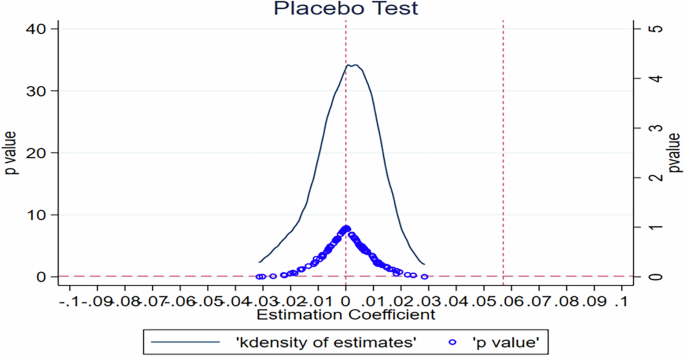
Therefore, this study randomly reallocated the values of the core explanatory variable GAlliance based on the actual proportion of firms involved in environmental protection strategic alliances while maintaining the original distribution of 1 and 0 s. Specifically, the assignment order was shuffled randomly to construct a placebo variable, GAlliance_random, thereby eliminating any real economic associations with the outcome variable. The specifications of all the other variables in the model remain unchanged. The baseline regression was then re-estimated using this randomised variable. To enhance the reliability of the test, the randomisation procedure was repeated 100 times. In every iteration, the regression was re-estimated using the placebo variable GAlliance_random and the resulting coefficients were documented. The distribution of the 100 estimated coefficients was plotted to examine the variability and statistical properties of the simulated results.
As depicted in Fig. 1, most of the coefficients clustered near 0 and lacked statistical significance, suggesting that, when randomly assigned, the environmental protection strategic alliances did not show a consistent effect on green innovation. By comparison, the estimated coefficient of the actual variable GAlliance was 0.057 (see Table 2), which was well outside the simulated distribution generated by the placebo test and fell within a statistically significant range. This suggests that the observed effect was unlikely to be the result of random variation and instead reflected a meaningful relationship with both statistical and economic significance. In conclusion, the placebo test results strengthened the credibility of the causal identification strategy used in this study, showing that the positive impact of environmental protection strategic alliances on corporate green innovation could not be explained by random variations or model specification errors but was instead backed by a solid empirical foundation.

link