

Technology has become a key component of Venterra Farms’ operations, facilitating both the harvesting and packaging of its best-selling products.
The farm, located in Salinas, has invested in implementing technological systems such as drip irrigation and specialized tractors with GPS satellite tracking, aiming to maximize the efficiency of its agricultural processes. These automated tractors allow for precise planting lines, contributing to better land use and a more efficient harvest.
“The tractor has GPS and autopilot. So the tractor drives itself and plants the line perfectly straight. You program it with what you want to do, and it follows,” said Ramón González Beiró, president and founder of Venterra Farms.
He explained that the adoption of these technologies is part of the company’s mission to optimize the planting, cultivation, and packaging of products destined for local supermarkets, particularly during the winter season, when the opportunity arises to replace imported products.
“We take advantage of this opportunity and can replace imported goods,” the president commented.
Currently, the farm has 350 acres of land—equivalent to 13,760,000 square feet—and maintains a payroll of between 28 and 30 employees. When asked by W JOURNAL about the staff’s reaction to the modernization of processes, Manuel Antonio González, executive director of Venterra Farms, assured that the response has been positive.
“What we do with 20 employees, we would have needed 50 before,” he emphasized.
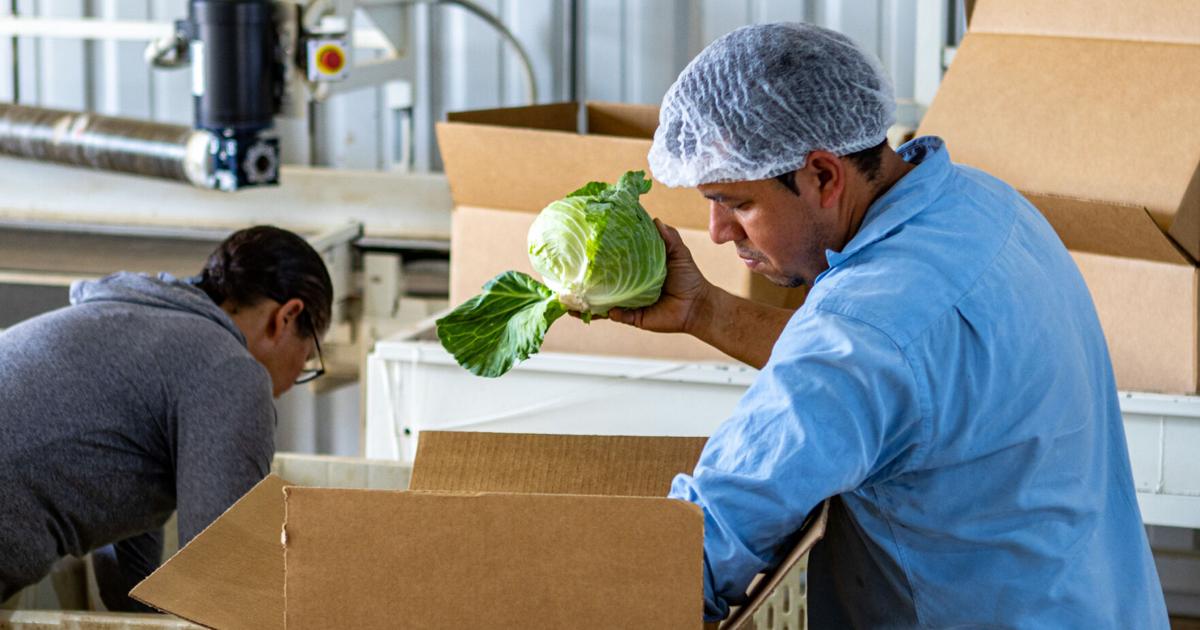
The company cultivates products such as pumpkins and bananas; however, most of its income comes from watermelon sales. They are also in a trial phase with cabbage cultivation, to which they have dedicated two acres of land, with an estimated production of around 100,000 pounds.
“The first cabbages are about to go on sale. We’re harvesting them now, and small quantities have already been sold to customers so they can see the quality,” said Ramón González Bennazar, vice president of Venterra Farms.

Ramón González Beiró with his sons.
The vice president explained that, for the time being, watermelon remains the main selling product, which is distributed at Sam’s Club and Walmart during the winter season.
“This is a product that is almost entirely imported here, and we are trying to replace those imports by supplying Walmart and Sam’s with this seedless melon,” he explained.
He added that the goal of the cabbage pilot project is to expand the range of local products available to Puerto Rican consumers.
“The idea is for it to grow and for us to be able to produce a similar quantity to the melon,” he commented.
Regarding the possibility of exporting, González Bennazar indicated that the company’s strategy is primarily focused on the local market.
“At one point, we did spend a year ‘exporting’ to the United States, but it wasn’t viable for us. So, everything we produce is sold on the island,” he noted.
The vice president also highlighted that, in recent years, the business has experienced sustained growth and that the company has now surpassed $2 million in sales, in addition to receiving a positive response from customers.
For market context, data from the Puerto Rico Department of Agriculture shows that last year, 76,171 quintals of cabbage were imported from countries such as the United States and the Dominican Republic.
“We have simply tried to provide the customer with a product of similar or better quality than what comes from abroad. Customers welcome local products if the quality is equal to or better than what is imported,” commented González Bennazar.
Investing in Local Agriculture
Given the growth of the local agricultural sector, Secretary of the Department of Agriculture Irving Rodríguez Torres affirmed that agriculture represents the future of food security on the Island and highlighted the agency’s efforts to create incentives and modernize agricultural processes.
“The increase in local agricultural production has been fundamental to guaranteeing access to fresh, quality food during times of global economic and logistical challenges. Thanks to the Department of Agriculture’s incentive programs, more farmers have been able to plant, harvest, and distribute products that go directly to consumers’ tables,” he stated.
According to data provided by the Department, between 32,000 and 55,000 quintals of products such as melons, squash, and plantains were imported, primarily from the United States.
“While we recognize the reality of the global market, and that our products are ‘Made in America,’ our priority is to create the conditions so that local products not only compete but are preferred. We incentivize local production, modernize farms, implement science and technology, facilitate access to institutional markets, and guarantee fair prices for farmers,” the official stated.