

Canadian agriculture is experiencing a revolution of technology. The wheels of the agriculture industry are in constant motion, with innovation at its heart. At Ag in Motion farmers can see the leading edge of technology but also revel in the glory of past innovations.
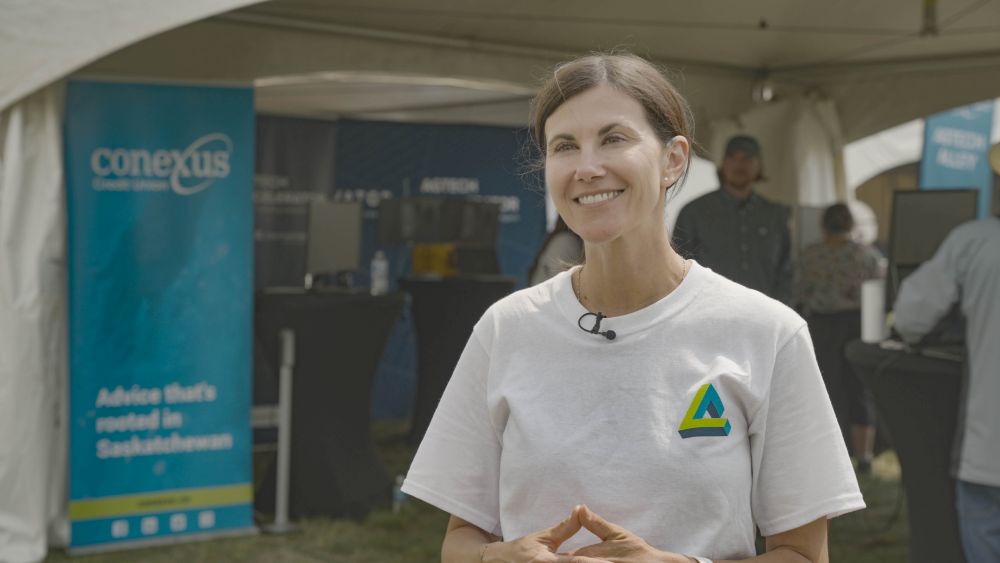
According to Laura Mock, director of Cultivator powered by Conexus, meeting the growing demands placed on farmers won’t happen without the integration of new technologies and innovation.
“Today, more than ever, farmers are being asked to produce greater yields to feed growing global populations,” Mock says. “They’re being asked to do more sustainable food development practices. There are all these pressures on farmers to just deliver more. And the reality is, without innovation, we’re never going to get those outcomes.”
Scott Garvey, senior editor of machinery at Glacier FarmMedia, sees a generational shift in farming with regard to technology. “The amount of knowledge required for technology is becoming a real specialized thing. A lot of farmers today are operating big machines, but they’re not under the hood. And that’s the difference from the generation I grew up in, to the generation that’s going to take over the farm now.”
Ag in Motion, Western Canada’s largest outdoor farm show, celebrates both legacy and innovation in Prairie farming. Antique tractors draw crowds with their history and craftsmanship, while cutting-edge machinery at the show points to the future of agriculture.
“To see people watching old tractors being operated in the field – even though they might be sixty or eighty years old – is pretty exciting,” says Ag in Motion show director Rob O’Connor. “But my favorite part of an agriculture trade show is all the new technology.”
Growing AgTech on the Prairies
Mock explains that Cultivator operates with a mandate and focus on agriculture technology. “Ag in Motion is a place where many companies and individuals are collaborating to solve agriculture’s most pressing challenges through the advancement of technology.”
That advancement includes everything from AI and sensor-based monitoring to data management systems and automation. Supporting this ecosystem is Cultivator powered by Conexus, a Regina-based tech incubator with a national and global reach.
“We know all innovation, regardless of the industry, will follow funding,” Mock says. “So, needing people that are focused on investing in those areas and bringing them together is such a critical component.”
The Cultivator AgTech Accelerator program has supported 62 companies, or “cohorts”, since 2022 by mentoring and providing connections that fast-track local innovators and companies on the Canadian Prairies.
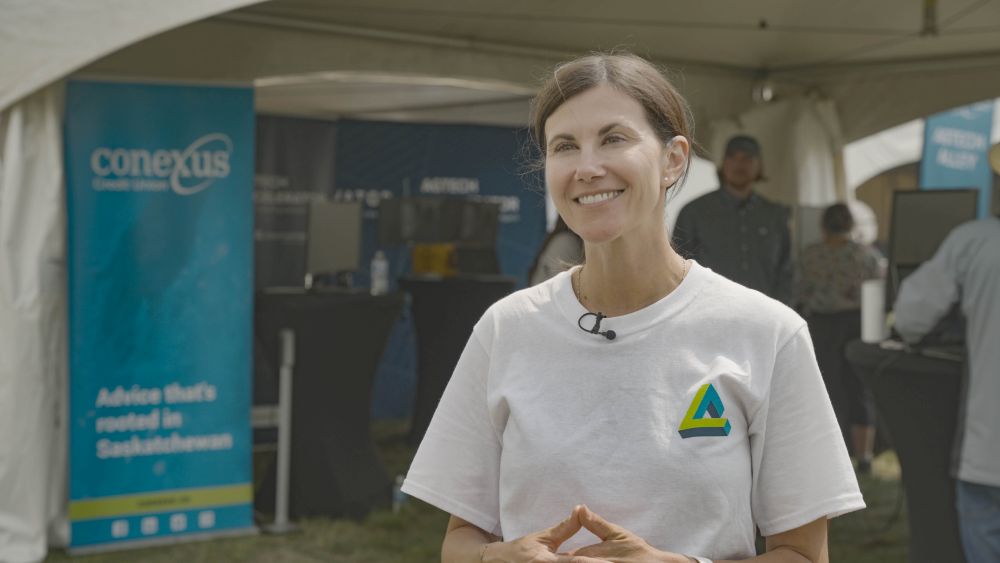
“Agriculture is such a big part of Canada and what we do,” Mock says, adding that Saskatchewan is uniquely positioned to lead agriculture innovation.
“Forty per cent of all of the farmland is in Saskatchewan, so bringing innovators, investors and industry leaders together in the heart of Canadian agriculture is the best place to grow agriculture innovation,” says Mock.
One of the earliest success stories from the program is FarmSimple, a company focused on monitoring livestock water systems. FarmSimple participated in the first Cultivator AgTech Accelerator Cohort in 2022. Theirs is a success story that shows how quickly an idea can go from concept to commercialization.
Katlin Lang, co-owner of FarmSimple, explains “our technology monitors all things water for your livestock and ag operation: water levels, temperatures, pressures, flows, allowing you to know that your animals have water while you’re not there. It started with a question from a friend who asked me if I could build him a product that could text him the status of his water level for his cattle while he was at the lake for the summer.”
Lang credits the Accelerator program with helping his company scale up. “The Cultivator AgTech Accelerator has been a significant help for FarmSimple and the growth of our products. We have made a ton of network connections that helped us find companies like Startup TNT who invested. That significantly helped our company grow.”
Two of the companies in the 2025 AgTech Accelerator Cohort are Chariot Command and Antler Bio. They attended Ag in Motion in July 2025 to expand their reach and promote their unique technology.
“Chariot Command uses cameras to understand the mechanical health of farm equipment,” says Andrew Leaman, CEO and co-founder of Chariot Command. “We put cameras onto machinery in dynamic environments, to help look for issues before they become a really big problem. We start with thermal imaging, and that allows us to detect fire and combine sparks. Finding those kinds of issues helps reduce downtime for farmers.”
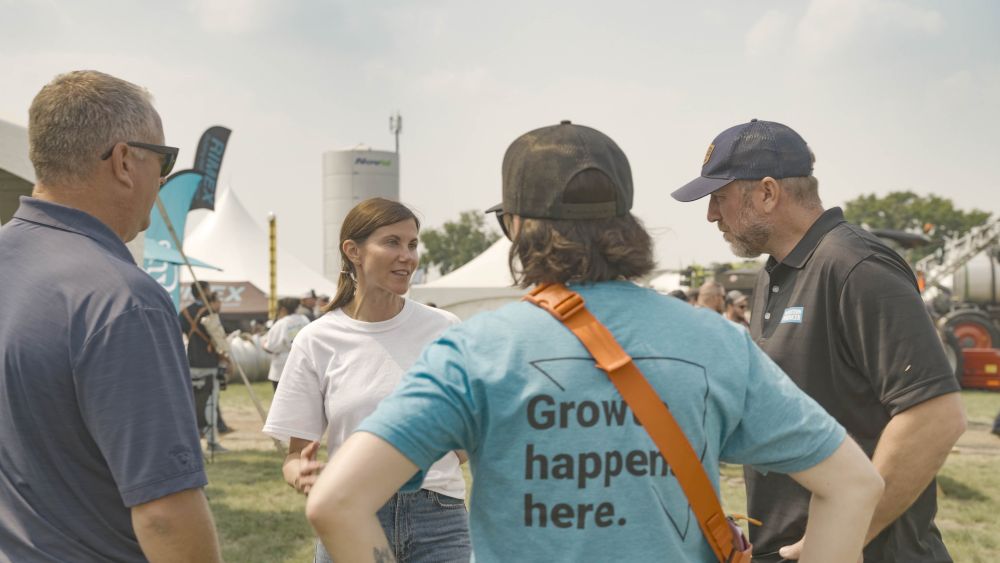
“Our Antler Bio decision support platform for dairy farmers is called EpiHerd,” says Andrew Lessey, COO, Antler Bio. “It’s designed to help improve the performance, efficiency and sustainability of dairy cattle. We’ve seen increases in performance up to 22 per cent and we do that by pioneering the use of epigenomics in livestock management.”
Both these 2025 Cohort companies benefit from the farm connections that the Cultivator AgTech Accelerator program provides. Talking directly with farmers for feedback informs and improves their products.
Lessey adds, “Everything we do is designed and developed in collaboration with farmers. We appreciate that they’re the most important people to support in order to get technology adoption. We demonstrate the impact so they can achieve a return on investment for their efforts.”
FarmSimple’s Lang also welcomes insight from farmers. “A key piece of feedback that we received was that although they don’t like to take a risk, they are happy to pay for a demo. If it doesn’t work out, we give them a refund. If it works, they’re happy with the payment and have a product they like.”
In three short years, Katlin Lang and his brother Dustin have developed a viable commercial product. They promote it to thousands of Western Canadian farmers that visit the FarmSimple booth at Ag in Motion. That’s the power of industry collaboration and expanded opportunities companies like Conexus can provide.
“Meeting with farmers and producers at Ag in Motion significantly helps our exposure,” says Lang.
Mock says their program emphasizes the importance of practical, impactful technology. “We’re looking for technology that makes sense on the farm and will make a difference. Having our finale week in conjunction with the Ag in Motion event helps because producers, industry leaders and governments from around the world are here at this show. We can highlight the strength of Canadian and Saskatchewan agriculture, and get these innovations in front of a very broad audience.”
The evolution of agricultural technology
For farmers looking for equipment solutions, Ag in Motion is one of the best places to see hundreds of millions of dollars’ worth of farm equipment in one place over three days in July. Scott Garvey reports on agricultural equipment and has seen the rapid evolution of machinery in agriculture.
“One of the unique things about farmers,” says Garvey, “is they will take a machine out, and think, ‘if only it did this or that would work better’. That attitude has led to so much innovation in production machinery. A lot of this technology originated on farms, in farm workshops,” Garvey explains.
Gerrid Gust, a farmer from Davidson, Saskatchewan, echoes this passion for early adoption and innovation. “We’re always looking to see what’s new and latest and greatest. I’ve tried being on the bleeding edge of a few things, and that’s usually painful, but once something’s run and proven technology, I’m first guy in. as an early innovator.”
A lot has changed in the last 100 years for farmers in Western Canada. In that short time, horse-drawn plows have been replaced by gas-powered tractors. Today, the latest farm equipment has auto-steer, sensors and software to operate without human intervention. These are just a few of the changes that help address farmer needs like comfort, efficiency, productivity and labour challenges.
Garvey recalls just how different early machinery was compared to what farmers use today.
“Some of the old cabs were the noisiest, dirtiest cabs you would ever ride in,” says Garvey. “They were just a metal box with windows. I once referred to them as Easy Bake ovens, because when the sun is shining, it gets to be about 110 degrees Fahrenheit inside the cab. Operator comfort is something that has changed a lot. Nowadays, farm equipment is just as comfortable as a car.”
Modern equipment improvements go far beyond comfort. Jeremy Hughes, product manager at HORSCH, explains.
“I would say that some of the features that we see today in air seeder technology that we wouldn’t have had a generation ago, revolve around productivity, overall efficiency and input management,” says Hughes. “Fifteen to twenty years ago, we had no section control systems, and we were also dealing with smaller machines. But as farms get bigger, as we need to be more productive, as our seeding windows get smaller, we have to get bigger units. We have to cover more acres per day.”
Technology is also transforming harvesting. Bergen Nelson, go-to-market manager at John Deere, describes how predictive automation is improving combine performance.
“We’ve got predictive ground speed automation on our new John Deere S7 Combine that’s allowing us to automatically control the speed of the combine and really that’s maximizing the productivity,” he says. “We’re seeing up to a 20 per cent increase with our customers who are running that in the field.”
These technological advances reflect broader changes across farming itself. Garvey notes how farm size and scale have evolved alongside machinery.
“I was recently in my hometown Tim Hortons, and I ran into a high school buddy,” says Garvey. “He and I grew up on the farm in the 1970s, and his family farm at that time was six quarters, while ours was four quarters. Today, he’s farming 22 quarters, and he’s still on his family farm, but it’s expanded greatly. So that kind of says a lot about what’s happened across agriculture.”
Farm labour shortages require innovative solutions
With over 30,000 farmers gathering at Ag in Motion every July, it’s easy to see the size of the agriculture industry. But the reality is, people who are able to work on a farm are a scarce resource. Labour shortages continue to be a growing challenge for farmers, not only in Western Canada, but around the world.
“One of the dynamics that we face here in Western Canada, but also at home in the U.S. and all across the world, is that we’re running out of people to help on the farm,” says Hughes.
Technology is increasingly stepping in to help bridge that gap.
Aaron Wetzel, vice president of production systems at John Deere, says automation tools are making it easier for operators to be productive from day one.
“Predictive ground speed is a real game changer for our customers,” Wetzel says. “One of the challenges that our customers have at harvest is finding qualified labour to run the machines and getting an optimal operator who can learn the equipment quickly as the season starts, in terms of productivity and operation. With the technology we now have embedded in these machines, operators can start day one.”
Wetzel notes that advanced automation can quickly level the playing field between new and experienced operators. “A few weeks ago, I was driving the John Deere X9 Combine in the field. I am not an experienced operator, but with the technology package we’ve got using harvest automation settings as well as the predictive ground speed, I’m operating at the level of the most advanced operators.”
Technology can help with the labour crunch on the farm, but will farmers accept robots doing their work?
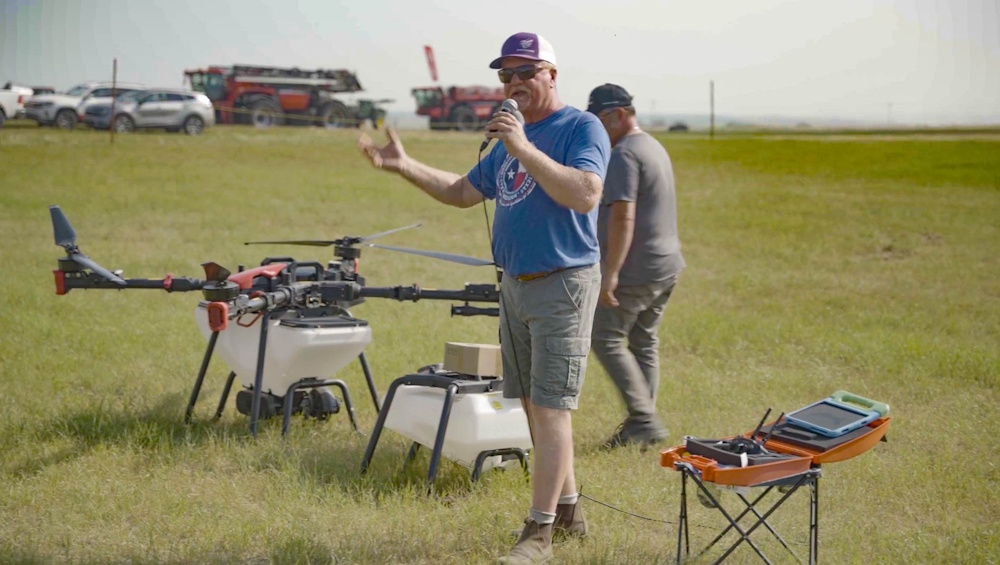
Peter Wall, co-owner of Elev8 Drone Service, says he sees drone technology growing rapidly in agriculture regions with advances in drone technology offering solutions to challenges that traditional equipment cannot always overcome.
“Before, we had to just rely on whatever the weather provided and do the best that we can. If a crop goes bad, or we have challenging weather, or we see patches that we would have to fertilize, sometimes we could not address those things because we couldn’t get in the field. Drones have solved this issue by flying into the field, creating no tracks or damage to the crop.
“Technology takes over so fast,” Wall says. “Even nowadays we have farmers who cannot quite believe that robot drones can do so much work when you just press a button and it’s all autonomous. I think farmers from long ago would have a hard time imagining today’s world.”
Looking forward and looking back
Farmers are aware of how much technology has revolutionized the agriculture industry. But the wistfulness for the old machinery still exists at Ag in Motion.
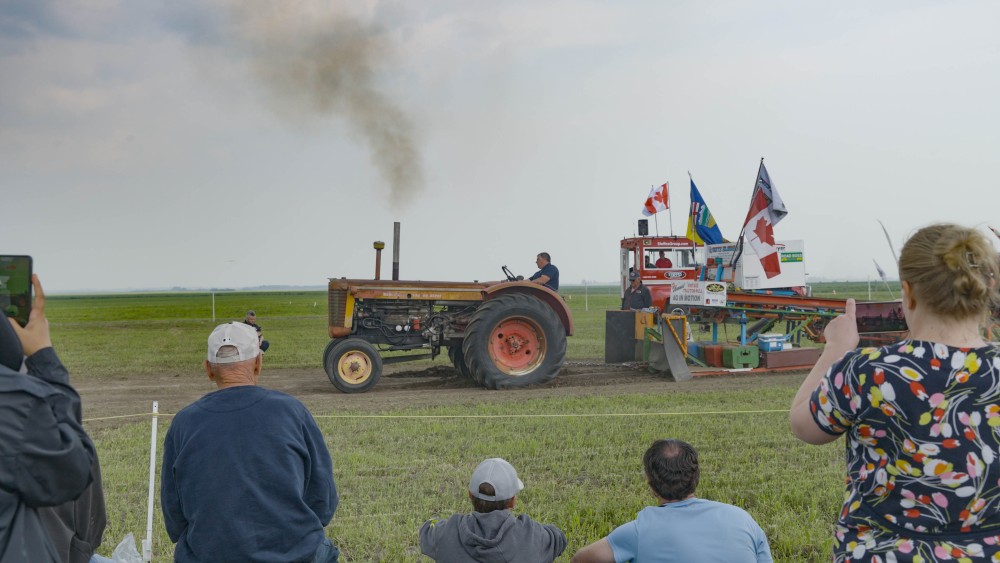
At the 2025 farm show, Garvey joined Jason LeBlanc from Steffes Auctioneers to host the Ag in Motion Antique Tractor Pull while crowds gathered to celebrate the nostalgic might of machines from the last century.
For many in agriculture, machinery is more than just metal and horsepower, it carries history, craftsmanship and personal meaning. According to Garvey, it’s an emotional connection that often forms between farmers and the machines they work with.
“I think if you appreciate machinery, you almost personalize it a little bit. You see an old vehicle or machine that’s derelict and you feel sorry for it and want to take it to your shop,” says Garvey. “I’ve rebuilt quite a few machines and when you do that, you get that sense of accomplishment and you’re left with something great – a machine that’s come back to the life it had when it came off the factory floor.”
That passion is shared by Russell Schultz, a tractor restorer who has built a collection rooted in family tradition.
“Well, it is a labour of love, really,” he says. “We’ve probably got 80 tractors in our collection and I love it. It’s a passion project to keep them going. My grandfather and dad collected old tractors, and I try and get most of mine out of the shed once a year.”
Even decades after leaving the factory, these machines can still perform. Tractor pull competitions – like those at Ag in Motion – keep classic farm equipment alive as a celebration of heritage, skill and enduring engineering.
Saskatchewan innovation brings technology to the world
Scott and the crowds at the Antique Tractor Pull are not the only ones who love a nostalgic look at farm machinery. Saskatchewan-born farm-boy Dave Hundeby is a designer and inventor whose patents are inside all kinds of farm equipment in Canada, the United States and Europe.
Innovation in agricultural machinery has long been driven by farmers themselves, turning practical challenges into globally adopted solutions. Hundeby of Elbow, Saskatchewan, traces that journey back to his own early inventions.
“Well, my very first patent was the tandem swather patent. I put a unit together in 1978, used it all fall and then sold to MacDon,” Hundeby says. “MacDon took that initial concept, and their engineer, Roger Patterson, did a great job of taking that and fine-tuning and perfecting it. They marketed those things and sold them all over the world.”
Hundeby says today’s equipment is advancing rapidly as automation becomes more sophisticated.
“As technology adapts, you can do more things automatically. We saw one booth at Ag in Motion that had a combine that would anticipate how heavy the crop is and slow down before the combine even gets there. So many technologies are coming that are just amazing. For seeding there was sectional control. That’s been huge.”
Ag in Motion show director O’Connor agrees that sectional control has had a big impact on Canadian farms.
“Sectional control has only been developed in the last 15 years, and it’s really been helpful for farmers,” he says. “Now you can use these very wide implements that have sensors to identify where there might be an obstruction, and the equipment turns on or off automatically to ensure you’re not spreading too much seed or fertilizer in an area where a crop won’t grow.”
For Hundeby, seeing those ideas still at work today brings deep personal satisfaction.
“There’s tremendous satisfaction, you know, to be able to start with designing a blower for an air cart and then designing the air cart and seeing how the whole industry has gone with it,” he says. “Now, when I go for a drive and see these machines I think, ‘Oh yeah, I helped design that’ or ‘our team did that’. To this day, I’ve got a few of those originals in my yard.”
While autonomy continues to develop, Scott Garvey says adoption will happen gradually.
“We’re probably going to see automation advance a little more slowly,” he notes, “with less critical jobs, like grain cart handling and some tillage applications. When we get into seeding and harvesting, where a small mistake can make a big impact on a farmer’s bottom line, I think farmers will be more reluctant to fully walk away and trust a critical operation like that to a robotic system.”
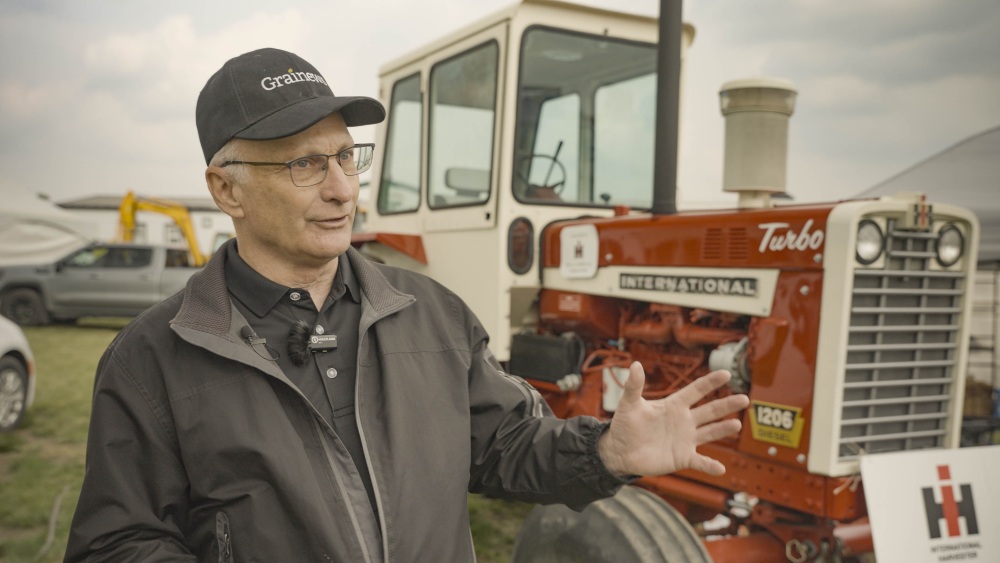
Farmers see how technology has already become essential in certain areas. Schultz points to guidance systems as a turning point.
“Auto-steer was sure one advance that definitely made farming easier,” Schultz says. “We’re farming more acres now and putting in longer days. Auto-steer and GPS let you keep going after dark. Back in the old days, tractors hardly had any lights. The lights were basically there to drive you home.”
And while robotics may be coming, Gust believes having real humans operating equipment will remain central to farming for years to come. “There’s talk about robotics and things replacing people, but it’s going to be a while yet. Maybe in my farming career, I’ll see autonomous farming, but you still have people sitting in it to grab it if something goes wrong.”
Together, these perspectives show how agriculture continues to balance innovation with practicality while building on decades of farmer-driven ingenuity.
Eyes are on Canadian agriculture innovation
With the advancements in the Canadian agriculture industry, it’s not just Canadian farmers closely watching the development of new technology in this country, but international audiences, too.
Ag in Motion continues to be a showcase for world audiences. Show director O’Connor highlights the international attention the show attracts.
“Ag in Motion has done a great job, with the support of groups like Saskatchewan Trade and Export Partnership, Saskatchewan Trade and Economic Development, as well as Global Affairs Canada – and our exhibitors – to attract international delegations,” says O’Connor.
“Delegates from countries like Australia, United States, Uganda, Mexico, Kazakhstan and Germany all come here because the equipment and the technology for small grains, oilseeds and dryland farming is the best technology around. Manufacturing is also done here in Saskatchewan, Alberta and Manitoba, and it’s recognized all over the world.”
Mock agrees and emphasizes that creating connections will be key to advancing agriculture technology in Canada.
“At the end of the day we hear from our program participants that it comes back to the age-old principle of ‘you don’t know what you don’t know’. Companies like Conexus are connectors. We are connected to experts all around the world,” she says. “To be able to bring everyone together at a show like Ag in Motion – in one place and in the field – with the purpose of advancing agriculture innovation … that’s huge.”
By combining cutting-edge technology with global networking, Ag in Motion is helping farmers, innovators, and experts push the boundaries of modern agriculture, one company at a time.
link